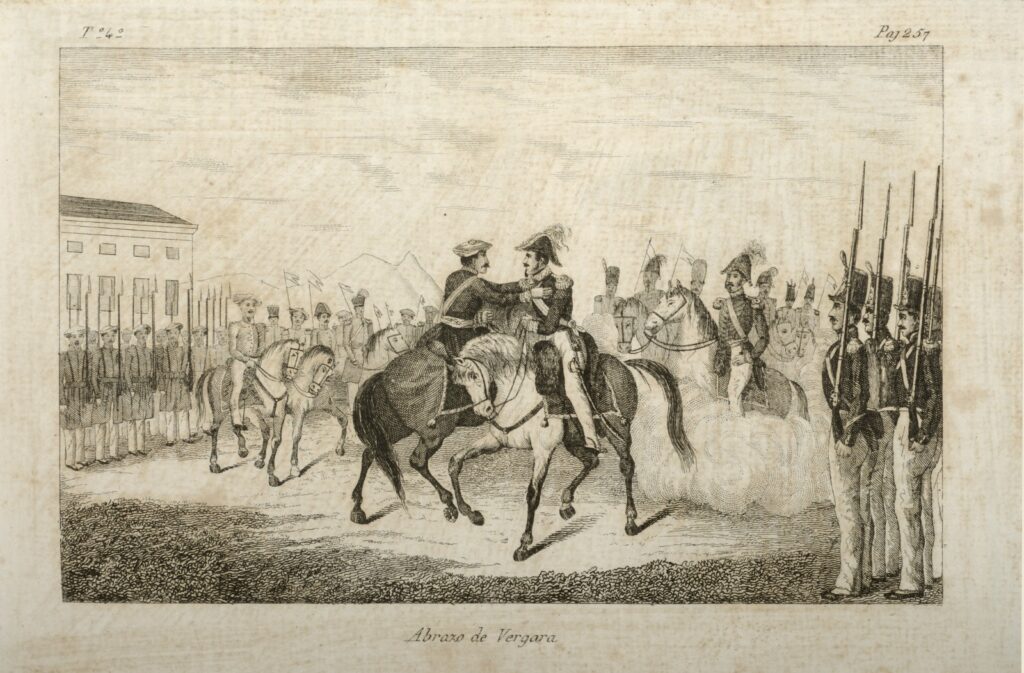
This was a large field at the edge of the town, between the Deva River and the road to Plasencia. There, very early in the morning, Espartero’s army formed up, and before it marched the Castilian division, led by General Urbistondo. Maroto, who seemed resurrected, judging by the sudden transformation of his demeanor, which regained its gallantry, as well as his face’s confident expression and healthy complexion, took his place; at once, the Duke of Victoria appeared with his brilliant staff, and having surveyed the lines, captivating everyone with his martial bearing and the serenity and contentment reflected on his face, he ordered his soldiers to fix bayonets; Maroto gave the same order to his men. Espartero, with that incomparable voice that possessed the power to ignite bravery, love, enthusiasm, and a noble spirit of discipline in hearts, delivered a short harangue, perfectly audible from one end of the formation to the other, and ended with these memorable words: “Embrace one another, my sons, as I embrace the General of those who were our enemies.” The two horses came together; the two riders, leaning their bodies toward each other, linked arms in a cordial embrace. Maroto was no less expressive of the two in the outpouring of that sublime concord. From one end of the ranks to the other, a cry resounded, like an explosion of weeping. These were no longer words, but a lament, the “Alas!” of the prodigal son upon being received back home, the “Alas!” of brothers who meet and recognize each other after a long absence. It was an awakening to life, to reason. The war seemed like a dream, a stupid nightmare.
Benito Pérez Galdós. Vergara (Episodios Nacionales).
Between April 17 and May 12, 1839, the Battle of Ramales took place, the last significant battle of the First Carlist War in the North. It resulted in a resounding Carlist defeat which, coupled with a lack of funds to pay his troops, placed Maroto, commander of the Carlist Army, in a precarious position.
The next four months marked a slow decline for Carlism, punctuated by conspiracies and mutinies, while the liberals continued their campaign of destructive raids led by Diego de León and Zurbano. Espartero, with the bulk of the army, advanced eastward from Ramales, slowly but inexorably.
At the end of June, through British mediation, Maroto attempted to negotiate peace, extracting some concessions from the liberals, but they were unwilling to compromise on anything beyond respecting the ranks and positions of Carlist officers. Throughout July and August, the Carlist army disintegrated, mutinies proliferated, and many units became uncontrollable. Furthermore, each province began to seek its own solution, starting with Gipuzkoa and then Biscay, chanting “peace and fueros” (regional privileges). The situation was chaotic, and Maroto’s threat to resume fighting if some of his demands were not met proved largely unbelievable.
Finally, on August 29, the agreement was finalized under liberal terms, and on the 31st, the Embrace of Vergara took place between Espartero and Maroto. Don Carlos and his loyal followers departed for exile in France, crossing the border on September 14. The last Carlist flag in the North was lowered on September 25 at the fortress of Guevara, which was subsequently destroyed.
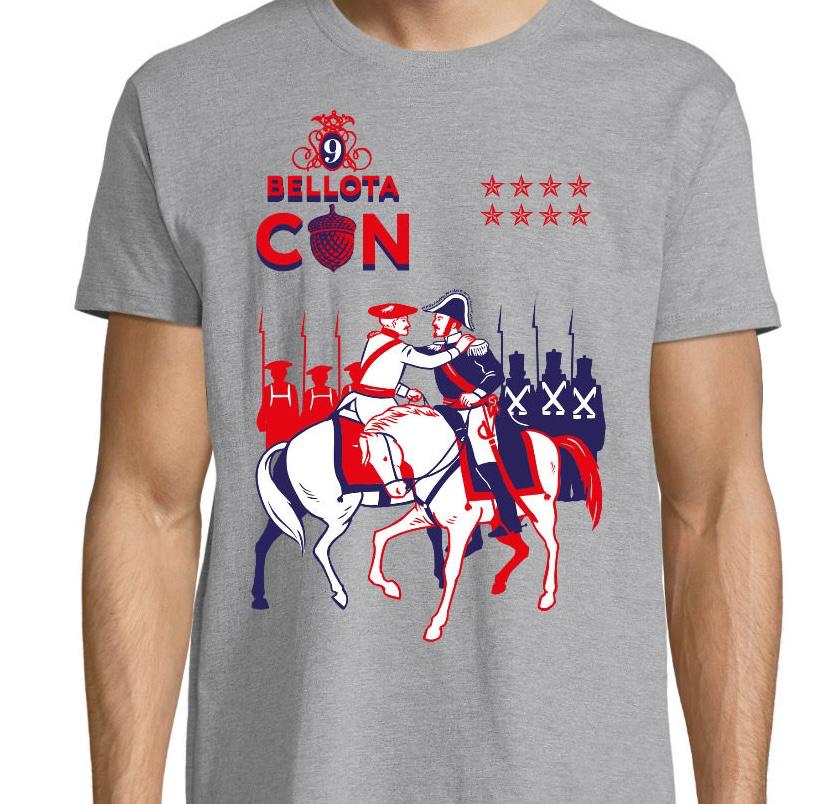
The design of the t-shirt for the 9th edition of the Bellota Con is inspired by the famous Embrace of Vergara, which sealed the end of the First Carlist War in the North and condemned to defeat the other main centers of traditionalism that survived in the Maestrazgo and Catalonia. The last Carlist troops, led by General Cabrera, crossed the French border on July 6, 1840, thus ending the war throughout Spain.
The Treaty of Vergara was imposed by the victors, but unlike what happened after the last Civil War (1936-39), the defeated did not suffer brutal repression in the postwar period. However, it was not an agreement that definitively settled the dispute, as Carlism survived as a political and social movement and would take up arms again on two other occasions: in the War of the Matiners, solely in Catalonia (1846-49), and in the Third Carlist War, once again throughout Spain (1872-76). There were also Carlists on the Nationalist side in the latter war, and it was precisely after that conflict, in which they were part of the victorious side, that Carlism began to decline, becoming, by the end of the 20th century, a residual ideology.
After designing the spectacular convention poster, Josean Morlesín has created a fantastic t-shirt design, perfectly suited to this year’s theme: the embrace of the two generals, Maroto and Espartero, with their troops in the background, standing at attention with fixed bayonets. The end of a terrible, pivotal conflict in our history, one that deserves to be rescued from oblivion. Recreating it at our gaming tables is another way to learn about and understand it.
David Gómez Relloso